Ralph Anderson
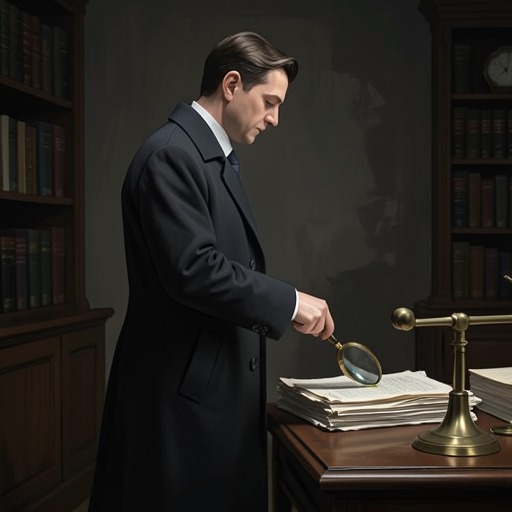
The Outsider (Stephen King Edition)Ralph Anderson’s investigation begins with conviction and an urgent decision: he believes Terry Maitland is the killer, yet knows the arrest is personal and that the case has not received the investigation he would ordinarily want. The contradictions that emerge after Terry is taken into custody expose the danger of turning persuasive evidence into certainty. Ralph’s arc is a reckoning with his own judgment, followed by a hard-won willingness to act on an explanation he once rejected.
Identity and the Arrest
Ralph is a Flint City detective, and at the time of Terry Maitland’s arrest the police force’s detective roster has been reduced by budget cuts to three full-time officers. Jack Hoskins is away on vacation, while Betsy Riggins, who should be on maternity leave, is assisting the State Police with another part of the investigation. These staffing circumstances help explain why Ralph is directly involved, but do not resolve his deeper misgiving: he knows he has no business being part of an arrest that feels intensely personal.
He is convinced the police have the right man. Even so, he would normally want to investigate an alibi first—find its weaknesses and establish the case before bringing the suspect in. The urgency of this case overrides that preference. Ralph and Bill Samuels jointly decide to arrest the suspected killer quickly; the choice to make the arrest at a Little League game, amid the crowd and celebration, is Ralph’s alone. The distinction matters: the decision to act is shared, but the public setting and its consequences are his responsibility.
Certainty, Evidence, and Error
After the arrest, Ralph’s confidence encounters an immediate complication. Terry is waiting in an interview room, his handcuffs removed before his lawyer arrives. Ralph watches through one-way glass and already feels uneasy about how quickly events have moved. Terry’s claim to have an alibi is not surprising to him; at first, he expects it to prove weak. That expectation captures the assumption governing the investigation: evidence against Terry seems so conclusive that conflicting information is treated as something to overcome rather than something that might change the theory.
The alibi and related details gradually make that confidence harder to sustain. Ralph recalls that a man who took Willow Rainwater’s cab addressed her formally rather than by name, and that the man who left a van behind Shorty’s Pub asked where to find a nearby clinic despite Terry having lived in Flint City all his life. Teachers could place Terry elsewhere at both the time of the abduction and the murder. His conspicuous appearance at Harlan Coben’s talk, where he rose to ask a question, seems almost calculated to ensure that he would be seen and recorded; even the fingerprints on the book appear too convenient. Each detail can be made to fit a suspicion of deliberate deception, but together they make the apparent case against Terry unnervingly perfect.
Ralph later recognizes the professional failure beneath that interpretation. He, Samuels, and State Police officer Yunel Sablo had agreed that checking Terry’s movements before the arrest might alert a dangerous suspect. Given the weight of the evidence, they regarded the precaution as unnecessary. Ralph calls that reasoning careless and admits that it feels as if he went blind. The retrospective language does not undo the choice; it marks the moment when a detective’s confidence turns into self-reproach.
His self-blame extends beyond procedure. Ralph wonders why he did not recognize the possibility of wrongdoing earlier, even remembering Terry in the ordinary setting of a backyard barbecue after Little League season. He also knows that this expectation is irrational: a person cannot read an unthinkable act in someone’s eyes during a commonplace encounter. Yet understanding that his guilt is irrational does not make it disappear. The strain between what he knows about the limits of ordinary observation and what he feels responsible for becomes part of his response to the case.
The Case’s Reversals
Ralph’s certainty is not merely an abstract belief; he supports it with evidence and says so forcefully to Terry’s lawyer, Howie Gold. After receiving a preliminary forensic update from a doctor at the hospital, Ralph tells Howie that the DNA comparison supports the accusation against Terry. The test results strengthen a case that already appears overwhelming, but they do not answer the central difficulty: how the evidence can implicate Terry when accounts and records place him elsewhere. For Ralph, the apparent strength of the proof initially intensifies the contradiction rather than resolving it.
The Peterson family’s destruction sharpens the moral weight of that contradiction. Ralph thinks of Frank Peterson’s broken bicycle chain as one circumstance that might have delayed him, but concludes that the decisive cause was the person waiting in the grocery-store parking lot—Terry, or someone wearing Terry’s face. He sees Frank’s murder as the event that first brought pollution into the family’s life and then destroyed it. This framing marks a shift in Ralph’s thinking: the name attached to the crimes remains central, but he begins to distinguish Terry himself from the identity used to commit them.
The image that gives shape to Ralph’s accumulating doubt is a seemingly sound cantaloupe found to be full of maggots. When he laughs with Samuels, the laughter is both recognition and release: the apparent object of the investigation looked whole from the outside, yet its contents made the ordinary explanation impossible to maintain. The book’s recurring images of contamination and abruptly ending footprints give Ralph a vocabulary for the gap between what appears orderly and what the facts disclose. They do not instantly supply an answer; they register the failure of his earlier certainty to contain the evidence.
A mundane errand becomes the occasion for a sharper reversal. On the way to Kroger with a grocery list from Jeannie, Ralph realizes that he may have interviewed Frank Peterson’s real killer as a witness, thanked him for his help, and let him go. The thought seems impossible because of the quantity of evidence tying Terry to the murder. Its force lies precisely in that impossibility: if the evidence can be abundant and still point to the wrong person, Ralph must reconsider what kind of case he is investigating.
Resistance and New Investigation
Ralph does not move directly from doubt to belief. At a meeting with Holly Gibney, he rejects her account of El Cuco as a supernatural being that preys on children. He acknowledges that the case—or the two cases, if they are connected—contains strange elements, but calls Holly’s theory a false trail. His resistance is grounded in the limits of what he can accept, as well as in his professional habit of seeking an explanation that can be tested through ordinary evidence.
The investigation nevertheless keeps pressing against those limits. Yune calls to report that something unusual was found in the barn where clothing associated with Terry was discovered. Later, Ralph and Jeannie review footage from the courthouse arraignment. Cameras from the network stations and Channel 81 recorded the shooting and the crowd; the images show Terry being shot, but the CBS recording goes blank before his death because Ralph’s bullet struck and shattered that camera. The footage brings Ralph’s own action into the same evidentiary record he is trying to understand, while also showing how incomplete any single record of the event can be.
Alec Pelley’s arrangements move the investigation beyond Flint City: the plane chartered by Howie is scheduled to depart at 9:30, and Ralph is asked whether he still intends to go. The trip reflects a shift from debating the possibility of an outsider to following the case’s connections and trying to identify the person behind Terry’s apparent double. When Ralph recounts a prior case, he identifies its subject from his iPad notes as Corporal Owen Sipe, evidence that even a pursuit involving a boogeyman remains, for him, work to be recorded and checked.
By the time the investigators face the danger at Marysville Hole, Ralph’s position has changed decisively. He tells the others that, for the day, the outsider exists, can read Claude Bolton’s mind, and is at the Hole unless they learn otherwise. He insists that they stop treating the question as a chain of hypotheticals and act on the working belief. The qualification is significant: Ralph is not claiming to have resolved every question about El Cuco or shape-shifting. He is accepting the immediate reality needed to protect the investigation team.
Relationships, Responsibility, and Ending
Ralph’s relationship with Jeannie provides a domestic counterpoint to the investigation. She is with him as they prepare to go to Howie’s office, accompanies him into the meeting with Holly, and shares the kitchen table with him while they review the courthouse footage on her laptop. Their life continues amid the case: Jeannie sends him to the supermarket because the Andersons still need groceries, whether the previous night’s disturbance was caused by a person, a ghost, or a vivid dream. Ordinary obligations persist alongside uncertainty, rather than waiting for it to be solved.
His relationship with Samuels is shaped by shared responsibility and the aftermath of their decision. They agree on the need to arrest the suspected killer quickly, and later Ralph’s unexpected laughter at the rotten-melon comparison is directed toward his colleague as an acknowledgment that they have badly misread the case. With Holly, the relationship follows a different course: Ralph first treats her supernatural explanation as a distraction, then comes to credit both her account and her willingness to believe that the impossible evidence is real. His change is therefore not only intellectual; it depends on a working partnership with someone whose conclusions he had initially dismissed.
At Marysville Hole, Ralph acts on that partnership when Jack Hoskins tries to point a gun at Holly. Ralph steps between them and fires three shots, telling himself that each is for one of the absent colleagues—Howie, Alec, and Yune. Hoskins falls, and Ralph reads relief in the dying man’s expression. The action is immediate and protective, a stark contrast with Ralph’s earlier decision to stage Terry’s arrest before properly testing the alibi. Here, he does not wait for certainty about every consequence; he responds to a direct threat to Holly and the others.
Ralph’s ending is an acknowledgment of dependence as much as a statement of belief. He thanks Holly for coming and believing, and says that she made him believe; without her, the outsider would still be out there. The remark does not erase his earlier refusal, nor does it absolve him of the cost of the arrest. It locates his hard-won change in a relationship: the detective who once trusted the apparent completeness of evidence learns to follow contradictions with another investigator, accept an explanation beyond his original framework, and act before certainty can offer comfort.